Proceedings & Doctrines
Key Terms to Know
Here are some common words that one may see when looking through doctrinal statements on Christianity, or when involving oneself in modern theological debates.
The Chalcedonian Debate
The Council of Chalcedon wanted to address theological questions about Christ’s nature, but unfortunately its decisions left the Christian world divided. For the Oriental Orthodox Church, the council’s conclusions were a betrayal of the faith that had been passed down from earlier church fathers, such as St. Cyril of Alexandria. For the rest who affirmed the council (these churches who would later split again to become the Eastern Orthodox Church and the Roman Catholic Church), these were important doctrines intended to weed out heretics. To this day, one must understand this council if they are to understand the division of the churches in modernity.
How Did The Council Begin?
The Beginning
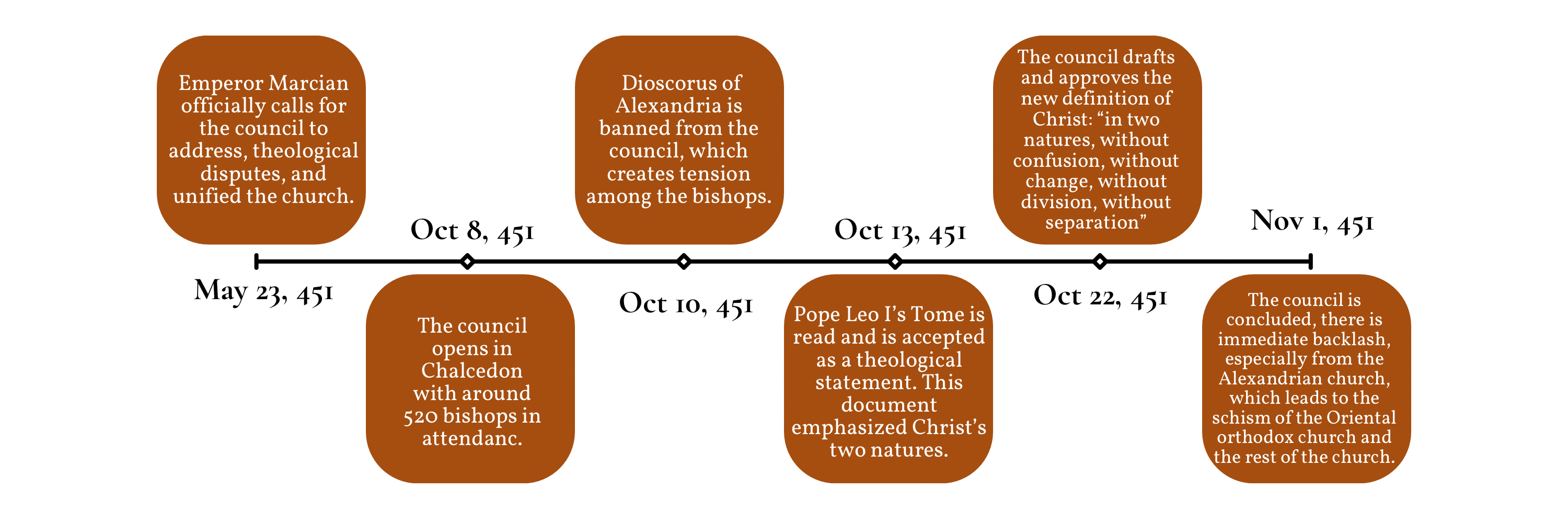
In 451 AD, Emperor Marcian officially calls for the Council of Chalcedon with intentions to unify the Roman Empire under a single Christian doctrine despite looming theological disputes. Bishops from all over the empire, including key figures from Rome, Alexandria, Antioch and Constantinople, were invited to participate. Around 520 Bishops showed up to attend this meeting.
Dioscorus of Alexandria
Only adding to the controversy, Dioscorus of Alexandria, who presided over the Second Council of Ephesus (449 AD), was not even allowed to participate in the council after being accused of being a heretic. This exclusion alienated a large part of the Church and set a rather odd tone for the proceedings, with many of the members seeing it as a move to lessen the Alexandrian influence.
Timeline of The Council
Dyophysitism vs. Miaphysitism: Two Perspectives on Christ’s Nature
At the center of the Council of Chalcedon’s focus was was the debate on how to articulate the relationship between Christ’s divinity and humanity. The Chalcedonian Definition declared that Christ exists “in two natures, without confusion, without change, without division, without separation,” a position now referred to as dyophysitism. This doctrine states that Christ’s divine and human natures remained distinct but united in one person. For the Chalcedonian supporters, this language was necessary to counter heresies like Nestorianism, which divided Christ into two persons, and Eutychianism, which denied His humanity (Chalcedon and the Need For Unity)
However, the Alexandrian tradition, which was represented by Dioscorus of Alexandria and is upheld today by the Oriental Orthodox Church, rejects the phrase “in two natures” in favor of miaphysitism. This is rooted in the teachings of St. Cyril of Alexandria, and miaphysitism states that Christ’s divinity and humanity are united in “one incarnate nature of God the Word.” This doctrine is able to depict the indivisible aspect of Christ’s divine and human natures after the union, which preserved the mystery of the Incarnation without risking confusion.
Despite the disagreements, both sides wanted to preserve the mystery of Christ’s humanity. Dyophysitism aimed to make sure that His two natures were not confused or merged. On the other hand, Miaphysitism strived to show the unity of Christ’s humanity, and wanted to avoid any language that could imply separation of his two natures. The debate seems to approach the same mystery with different theological stances. Subsequent dialogues between Chalcedonian and Oriental Orthodox Churches have revealed that much of the division was rooted in language barriers and cultural misunderstandings rather than overt doctrinal differences. Efforts to reconcile these differences still continue to this day.
Overview of Chalcedon
Click below to watch an informative video covering an overview of the sessions of the council.
The Final Outcome
In The End, The Council Decides On Dyophysitism
The Council of Chalcedon ultimately affirmed the Chalcedonian Definition, which states that Christ is fully divine and fully human, existing in two distinct natures united in one person. They felt it was correct because it addressed heresies like Nestorianism and Eutychianism,which had affected Christian doctrine across much of the Roman Empire.
Despite its intentions, the council ended up widening the gap between believers in Christ. Many Christians in Egypt, Syria, and Armenia rejected its decisions, which lead to a schism with the Oriental Orthodox Church that persists to this day.